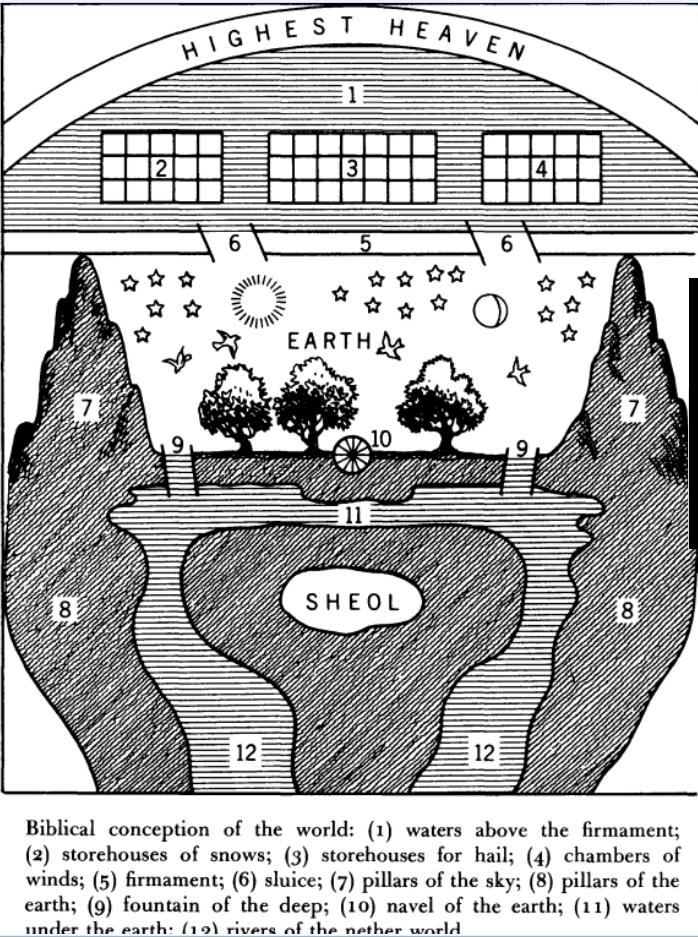
The Second Day of Genesis 1 Describes … What?!?
Then God said: ’Let there be a rāqîaʿ in the midst of the waters, and let it keep separating the waters from the waters. So God made the rāqîaʿ, and he separated the waters which were under the rāqîaʿ from the waters which were above the rāqîaʿ. And it was so. Then God named the rāqîaʿ: “Sky! (/ Heavens!)” And there was evening, and there was morning, the second day. – Genesis 1:6-8
For thousands of years this passage has been an enigma for interpreters of the Bible. 1 What is the meaning of this word ‘rāqîaʿ,’ and what exactly were these waters that it divided? Was this simply describing the creation of the atmosphere? Do these upper waters simply refer to the clouds? Or are there details in this passage that make those interpretations problematic? Looking at this passage within its context, we must also wonder: What is it about this event that an entire day of creation was devoted to it? And what relation does it have to the works God performed on the other five days of creation?
While it may come as a surprise to many, modern scholarship has long argued that the Hebrews, along with most other ancient peoples, believed that the heavens (as in ‘the sky’) 2 were made of some kind of solid substance, whether it be of bronze, iron, or precious stone. This heavenly vault or dome had hatches in it, so it is argued, that released the waters that were contained above it. According to this view, this was the ancient explanation for where rain comes from. While this modern scholastic view goes well beyond what pious ancient interpreters thought, we can conveniently group together all views that thought of the rāqîaʿ as a solid object the firmament concept. ‘Firmament’ being the well-known King James Version translation of the Hebrew word rāqîaʿ.
One may question if such a view is nothing more than a modern scholarly invention. As understandable as that would be, the very etymology and long-term usage of the (English) word firmament testifies that the notion of a cosmic ‘vault,’ or conversely of some kind of crystalline celestial sphere (which concepts, however, are far from identical), 3 has long been believed in. Firmament is a transliteration of the Latin Vulgate’s firmamentum, the Vulgate being a 1,600 year old translation. The Vulgate itself was influenced by the Septuagint’s στερέωμα (stereōma), the Septuagint itself being a 2,300 year old translation. Stereōma comes from the word στερεόω (stereoō) – ‘to make or be firm or solid.’ While secular scholarship and conservative belief alike distinguish between the original intent of the Bible and later interpretations of it (no matter how old those interpretations may be), it is nonetheless a remarkable fact that the earliest ever translation of the Hebrew Bible, from circa 250 B.C., interpreted the rāqîaʿ as referring to some kind of hard heavenly object.
In summary, this ‘dome theory’ or ‘firmament notion’ represents the almost unquestioned consensus view of modern scholarship, while ancient Jewish and Christian interpretation has itself long supported important aspects of this model. Furthermore, while a segment of scholars, almost entirely from the evangelical community, previously opposed this view, particularly in light of the scientific problems it introduces, an increasing number of professing evangelical scholars have now openly embraced the firmament interpretation. The earlier evangelical view is represented by the translation of rāqîaʿ as an expanse, rather than as a firmament or dome:
NIV (1984): Let there be an expanse between the waters … NRSV: Let there be a dome in the midst of the waters …
<
p class=“Citation”> Typically, those arguing for this alternative explanation imagined that this expanse (i.e. the rāqîaʿ itself) represented the atmosphere, 4 as opposed to a solid cosmic vault. A crux of their argument was that even though the root word behind rāqîaʿ (rqʿ) can indeed denote the notion of solidity, that it could also denote the verbal notion of expansion. From this latter sense they advocated that the rāqîaʿ should be translated an expanse. Nonetheless, the proponents of the firmament view argue that even aside from this word’s etymology, there are many contextual and historical lines of evidence that seem to strongly support the firmament interpretation.
Typical Descriptions of the Firmament Model
To get a better idea of what modern scholarship imagines when they speak of the firmament, as the purported view of the ancient Hebrews and their Scriptures, consider the following depictions, which are just a few out of the tens, if not hundreds, that one encounters:
The description given in Genesis 1:6-7 of the creation of the heaven indicates clearly that the Hebrew cosmologist conceived the sky to be a rāqîaʿ, a solid material stretched out, which contained within its upper surface ‘the waters above.’ Old Testament man saw ‘that inverted bowl we call the sky’ as a solid, crystalline material, above which ‘the waters which are above the firmament’ were contained, and within whose solid, transparent mass the heavenly luminaries performed the mechanical function assigned to them by the Creator… (David Neiman, “The Supercaelian Sea,” JNES 28:4 (1969): 243)
And:
The ‘classic’ cosmology [of the Hebrews], originating in its fundamentals in Mesopotamia, … took on quasi-canonical authority through the influence of Gen 1. In it, heaven is a solid vault (Ps 19:2[1]), which keeps the waters of chaos above and beside it from invading the cosmos (Gen 1:6-8; Ps 148:4). To it are attached as lights the sun, moon, and stars (Gen 1:14-17). It has openings through which the waters of chaos can once more invade the world during the deluge (Gen 7:11; 8:2…; 2 Kngs 7:2,[19], which Hertzberg erroneously mentions in the same breath, has to do with hatches that Yahweh could make in heaven: there is no mention of any cloudburst). According to 2 Sam 22:8 and Job 26:11, this enormous bell-shaped firmament rests on a foundation (pillars, analogous to the išid šame of the Babylonians), as do the earth (Ps 75:4[3]; 104:5; Job 9:6 …) and the mountains (Ps 18:8[7]). (G. Bartelmus, “שָׁמַיִם,” TDOT 15:211.)
And again:
In the Hebrew Bible ‘heaven’ is sometimes used as a synonym for ‘firmament’ (Heb rāqîaʿ) to describe the dome-shaped covering over the earth that separated the heavenly waters above from the earthly waters beneath…. Whereas the firmament referred specifically to the canopy covering the earth, heaven often had a broader meaning, referring to all that was above the earth, including the firmament. (Mitchell G. Reddish, “Heaven,” Anchor Bible Dictionary 3:90.)
I will refer to this consensus view as the firmament concept, and will only use the term ‘firmament’ when referring to that notion. 5 Conversely, I will use the word rāqîaʿ and the designation rāqîaʿ concept as a way of referring to this scriptural entity in an interpretation neutral manner. It must be emphasized that the firmament concept is not limited to instances in which the word rāqîaʿ is used, which in fact only occurs in six chapters of the Bible. To the contrary, in the vast majority of cases in which a reference to the cosmic vault is supposed, the underlying Hebrew word is šāmayim or one of its synonyms rather than rāqîaʿ.
Summary of the Evidence for the Firmament Model
The firmament concept of modern scholarship can be seen as resting on five chief arguments:
- The root rqʿ (the reader may pronounce this ‘raqah’) has the basic notion of stamping or of hammering something out thin, often in reference to a metallic substance.
- Numerous passages throughout the Bible seem to depict heaven as something solid, if not even as a solid vault (e.g. Job 37:18).
- Occasional statements concerning the ‘windows of heaven’ as well as references to ‘the heavens being opened’ in conjunction with heavy rainfall (Gen 7:11) are thought to refer to hatches within the cosmic vault whose openings release the waters above.
- It is claimed that virtually all ancient peoples thought of “heaven” or of “sky” as being a solid object, or, that some such solid object existed within the (spacious) sky.
- Although used in an auxiliary manner, it is noted that the later Jewish and Christian interpretations anteceded today’s consensus view by as much as a couple thousand years.
To see my answer to all of this, continue reading here.
Footnotes
Since this topic only rarely involves New Testament passages, “bible” in this work usually refers only narrowly to the Hebrew Bible / the ‘Old Testament’.↩︎
‘Heaven’ as in ‘the sky above’ rather than as a seclusively supernatural place beyond. I have found that there is often confusion on this point, which arises from the modern usage of the word ‘heaven’ as referring almost exclusively to a supernatural place separate from our physical cosmos. In my view, the two notions are in fact blended in the Hebrew notion of heaven. That is, the Hebrew heaven is almost never totally disassociated from the physical ‘cosmos’ (or from ‘the sky above’), even while ‘God’s heavenly abode’ neither loses its ‘other worldly’ quality.↩︎
This was the dominant interpretation in the church throughout much of its history, even with and beyond the time of Nicolas Copernicus. It is important to note, however, that the crystalline celestial sphere model differs remarkably from modern scholarship’s cosmic vault. The latter, for instance, usually presumes a flat earth with the cosmic ‘vault’ sitting over it (resting on pillars, for instance). Clearly, the crystalline celestial sphere(s) of Copernicus did not rest on a flat earth, as he obviously believed in a round earth, as did almost the entirety of the church fathers that preceded him. Furthermore, these prior views sometimes thought of the purported substance of the ‘firmament’ as being aetherial, ‘other-earthly.’ What these views do share in common is the notion that the rāqîaʿ – for them ‘the firmament’ – represented some kind of solid celestial object.↩︎
As will be stated below, I believe the term ‘atmosphere’ (and others like it) must be used with great caution due to how highly defined a term it is for us moderns.↩︎
It bears repeating, however, that past Jewish and Christian interpretation typically varied widely from modern scholarship’s more primitive firmament model.↩︎